Master Your Infrastructure with Proxmox: The Open-Source Virtualization Game-Changer
In the world of server administration and virtualization, finding a solution that is powerful, flexible, and open-source can often feel like a pipe dream. Look no further! Today, I want to talk to you about Proxmox Virtual Environment (VE), a platform that has revolutionized how I manage my resources, and I’m sure you’ll love it too.
What is Proxmox and why should you care?
Proxmox VE is an open-source virtualization platform based on Debian GNU/Linux. What makes it stand out is its ability to manage two industry-leading virtualization technologies: KVM (Kernel-based Virtual Machine) for full virtual machines and LXC (Linux Containers) for lightweight containers—all through a single, intuitive web interface!
Imagine being able to create and manage virtual servers with different operating systems, deploy applications in efficient containers, and do it all from a centralized control panel accessible via your browser. Sounds great, right?
Proxmox’s "Crown Jewels":
- Dual Virtualization: The combination of KVM and LXC gives you the flexibility to choose the best technology for every need. Need a fully isolated operating system? KVM is your ally. Looking for speed and resource efficiency? LXC will blow you away.
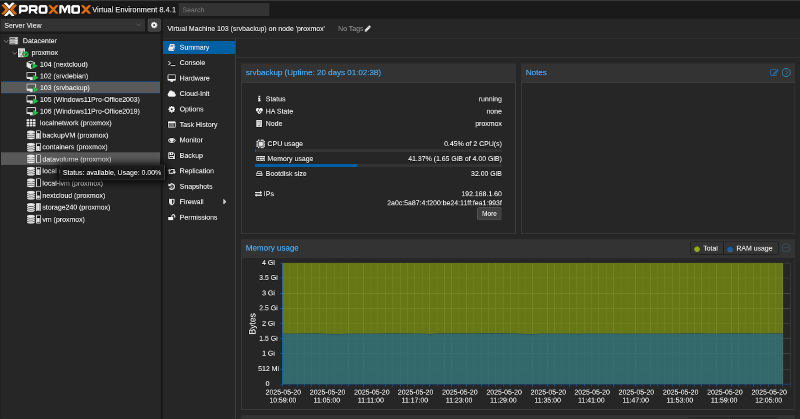
- Centralized Management: Forget juggling multiple tools. Proxmox offers a unified view of all your virtual resources, making it easy to create, configure, monitor, and manage your VMs and containers.
- Open Source & Free (with optional support): Proxmox’s open-source nature means you have a massive community behind you, constant updates, and the freedom to use it without licensing costs. If you need enterprise-grade support, subscription options are also available.
- Flexible Storage: Proxmox supports a wide variety of storage solutions, from local storage to shared systems like Ceph and ZFS, allowing you to tailor your infrastructure to your specific needs.
- Advanced Networking: Configuring complex networks with bridges, VLANs, and load balancing is surprisingly simple thanks to the Proxmox interface.
- Live Migration: Need to move a virtual machine from one host to another without downtime? Proxmox makes it possible with its live migration feature!
- Integrated Backup and Restore: Protecting your data is crucial. Proxmox includes built-in tools to perform efficient backups and restorations.
- High Availability (HA): For critical environments, Proxmox offers HA functionality, allowing VMs to restart automatically on another node in case of hardware failure.
My Experience with Proxmox:
Personally, Proxmox has vastly simplified my infrastructure management. The ease with which I can create new test environments, deploy apps, and perform backups is impressive. The web interface is intuitive and provides a clear overview of the status of my servers and resources at all times.
Who is Proxmox for?
Proxmox is an excellent choice for:
- System Administrators: Looking for a powerful and flexible platform to manage virtual servers and containers.
- Developers: Who need fast, isolated testing environments for their projects.
- Businesses of all sizes: Seeking a robust and scalable virtualization solution without the prohibitive costs of proprietary software.
- Tech Enthusiasts: Who want to experiment with virtualization and learn about server administration.
Conclusion:
If you are looking for a virtualization solution that offers power, flexibility, a great community, and the freedom of open source, I highly encourage you to explore Proxmox Virtual Environment. I am sure that, just like me, you will discover a world of possibilities to manage your infrastructure efficiently and effectively!
Have you tried Proxmox? Share your experience in the comments!
Sign IN
Comments: (0)
There are no comments yet.