When people talk about the EUDR, the conversation usually stays at the legal level: what must be declared, by when, with what penalties. But the question that actually determines whether a company can comply is both simpler and harder: how do you capture the origin data for each log, at the felling site, with no internet connection?
I've been solving this exact problem since 2006 for clients in the Republic of Congo, and the answer looks nothing like what you'd imagine from an office in Europe.
The real problem isn't technical, it's operational
A forestry concession in Central Africa can span tens of thousands of hectares, with no mobile coverage, and felling crews working hours away from base camp. Any system that depends on a constant connection to function simply doesn't work there.
How the data is captured at the source
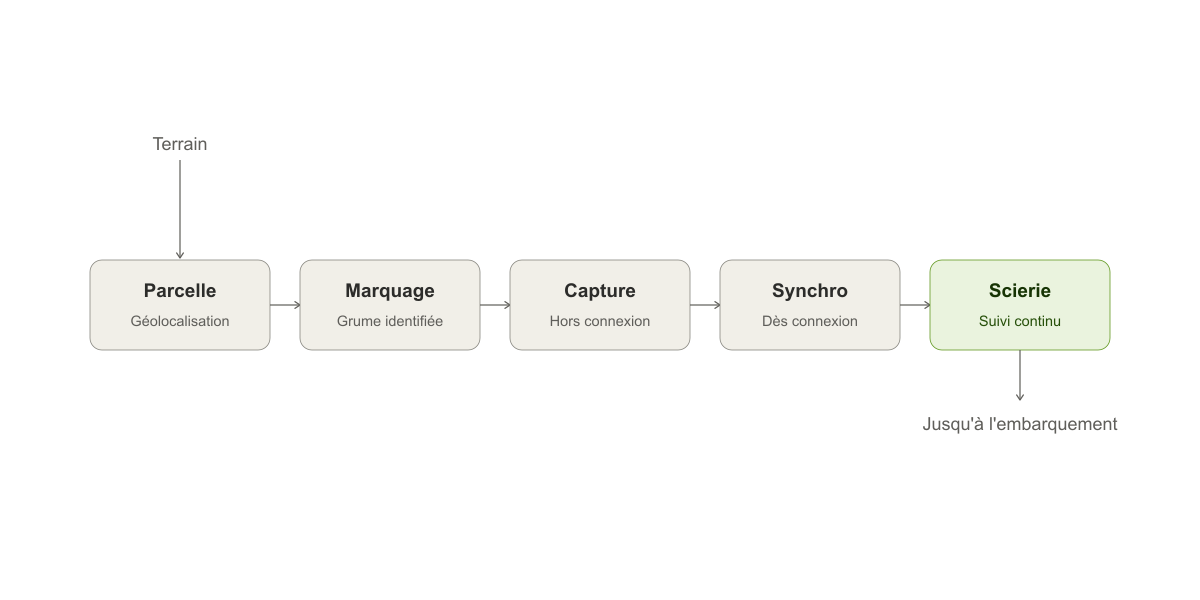
The process, simplified:
- Plot geolocation, before felling, via handheld GPS or field equipment.
- Physical marking and unique identification of each log, linked to that plot.
- Data capture at the felling point — species, diameter, coordinates — on a device that runs offline, storing locally.
- Synchronization whenever a connection is available (at camp, on the road, on arrival at the sawmill), without losing or duplicating data even if sync is interrupted.
- Continuous tracking of the log through every transformation — transport, sawmill, drying — to shipment.
Why this is exactly what the EUDR requires
The regulation requires proving the geolocated origin of every batch of timber entering the EU. A system that has already captured this chain since 2006 doesn't need to "adapt" to the EUDR — it already has the data. What's needed is an export and reporting layer that translates that internal data into the format the EU system requires (the Due Diligence Statement), which is exactly the work I'm now doing on top of these existing systems.
The difference between designing for audit and designing for the field
Many traceability systems are designed with the final report in mind first — certification, audit — and the field has to adapt as best it can. This one was designed the other way around: first solve how to capture data reliably where there's no network or stable power, with reporting coming afterward, as a consequence of well-structured data from the source. That difference is what lets the system scale to new regulatory demands — the EUDR today, whatever comes next — without redesigning anything from scratch.
Let's talk about your EUDR traceability
Sign IN
Comments: (0)
There are no comments yet.